What Can We Learn When the Crop Doesn’t Go According to Plan?
There are years when a crop trial looks exactly how you pictured it when you drew it up on paper. Everything emerges evenly, the weather cooperates, the weeds stay where they belong, and by August you have beautiful side-by-side comparisons to show everyone.
Then there was 2026.
When we met producer Byron Long and Dr. Bart Lardner in the field for our Stalk Walk on August 26, nobody was pretending it had been an easy growing season. Excess moisture, standing water, weeds and delayed crop development had all left their mark. Some of the plans for the project had worked, some had changed along the way, and some simply hadn't happened because there were stretches when Byron couldn't get equipment across the field.
For a project designed to look at different ways of producing annual forage for cattle, that might sound less than ideal. In reality, it gave us plenty to talk about.
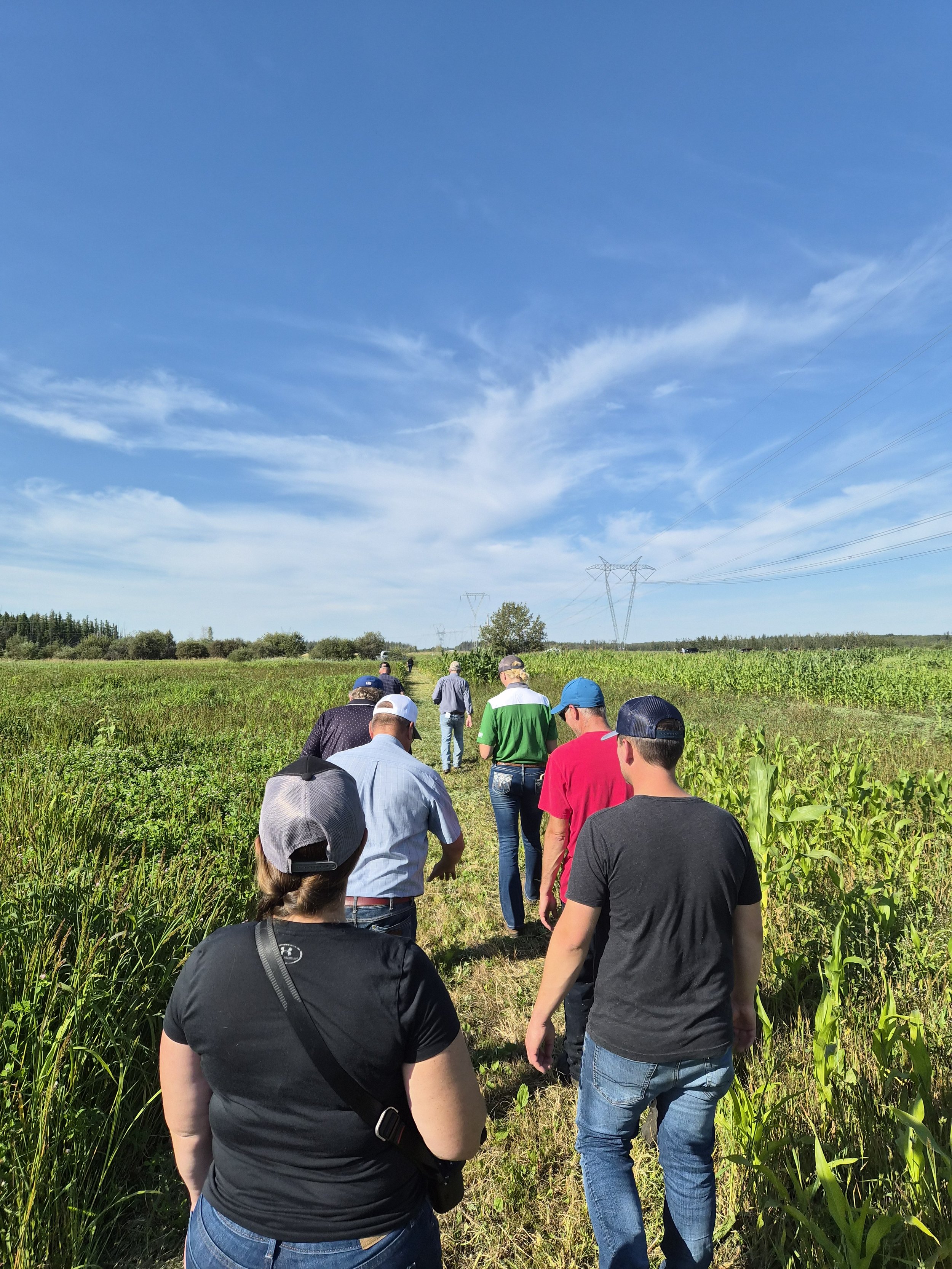
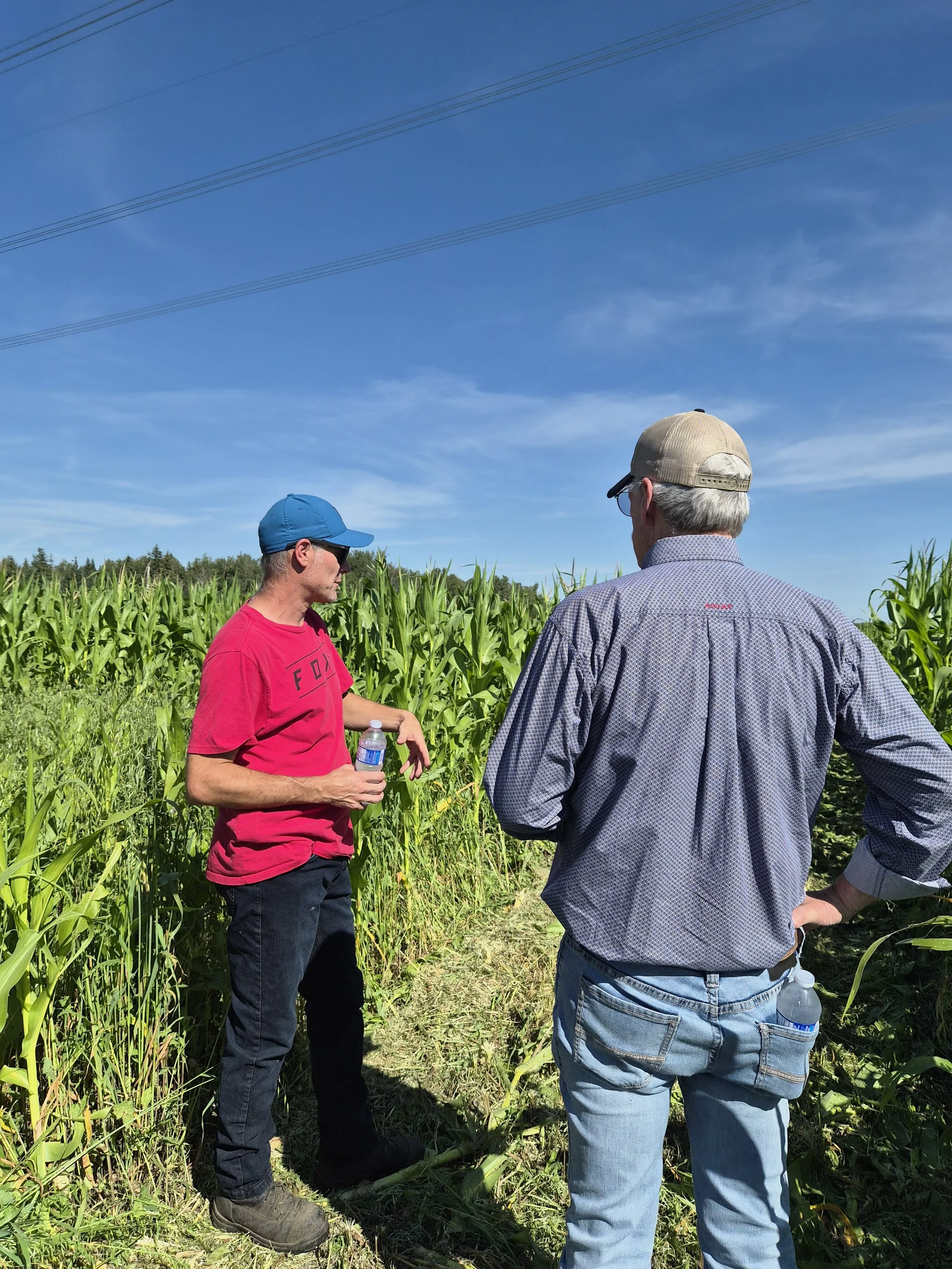
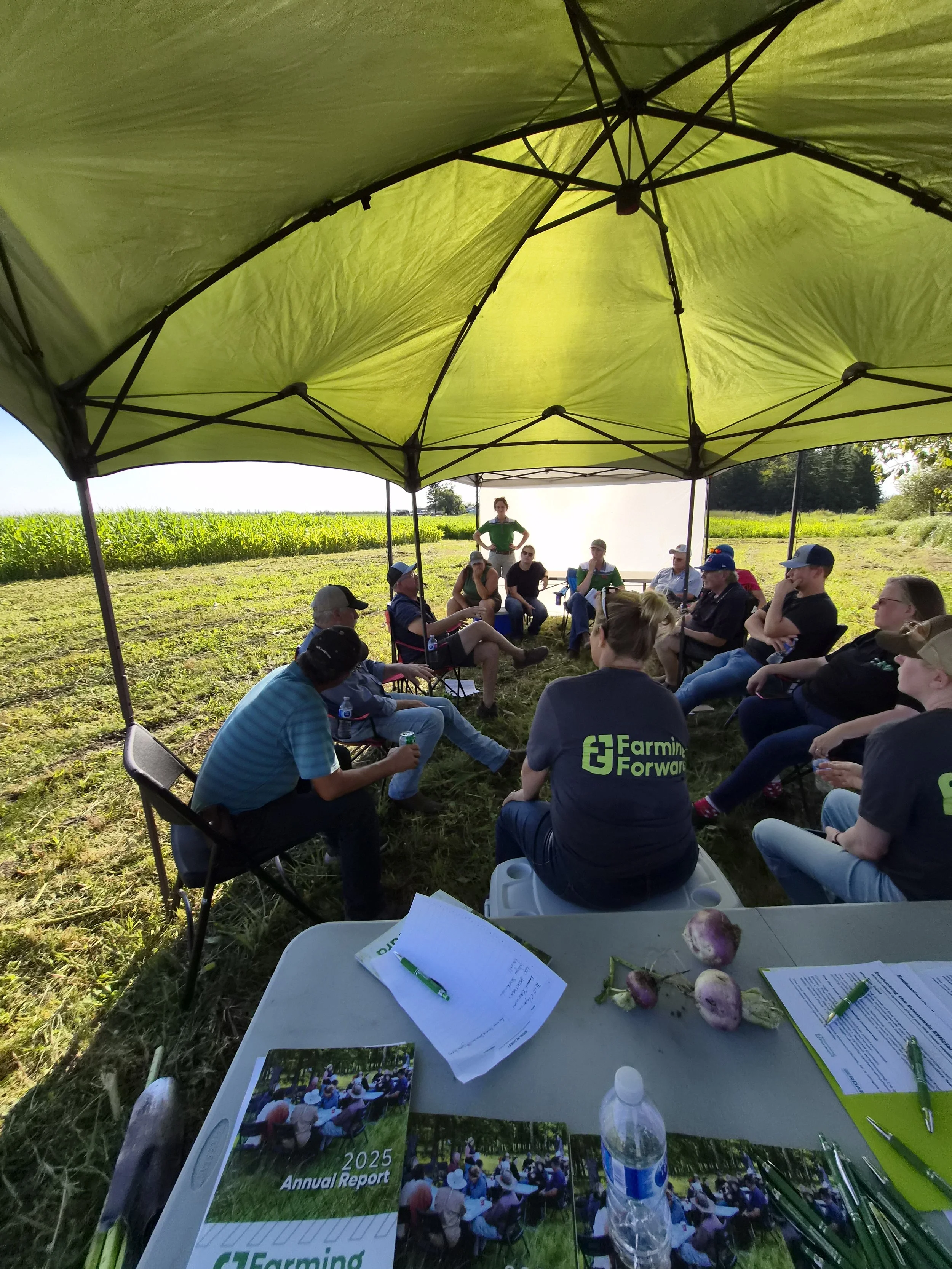
The afternoon started with Bart and Byron walking through the field together, pulling apart plants, comparing crops and talking about what Byron had tried and why. Byron puts a lot of thought into what might work better on his farm and isn't afraid to put those ideas into action. That approach gave us plenty to look at, with different crops, varieties and management strategies to compare across the field. As more producers joined us, the conversation expanded from what was growing in front of us to silage, grazing, feed quality and how these different systems might actually fit on a cattle operation. By supper, everyone was sitting around talking about rumen microbes, feed efficiency, cow size, genetics and just about everything in between.
It was less of a formal field tour and more of a few hours spent asking, "Okay, what happened here?" And, maybe more importantly, "What can we learn from it?"
There was a little bit of everything
The Silage Systems project includes corn, barley, cereal and pea combinations, and more diverse annual forage mixes. Byron also had some questions of his own, so the field ended up with additional comparisons of corn varieties, populations and configurations he wanted to try.
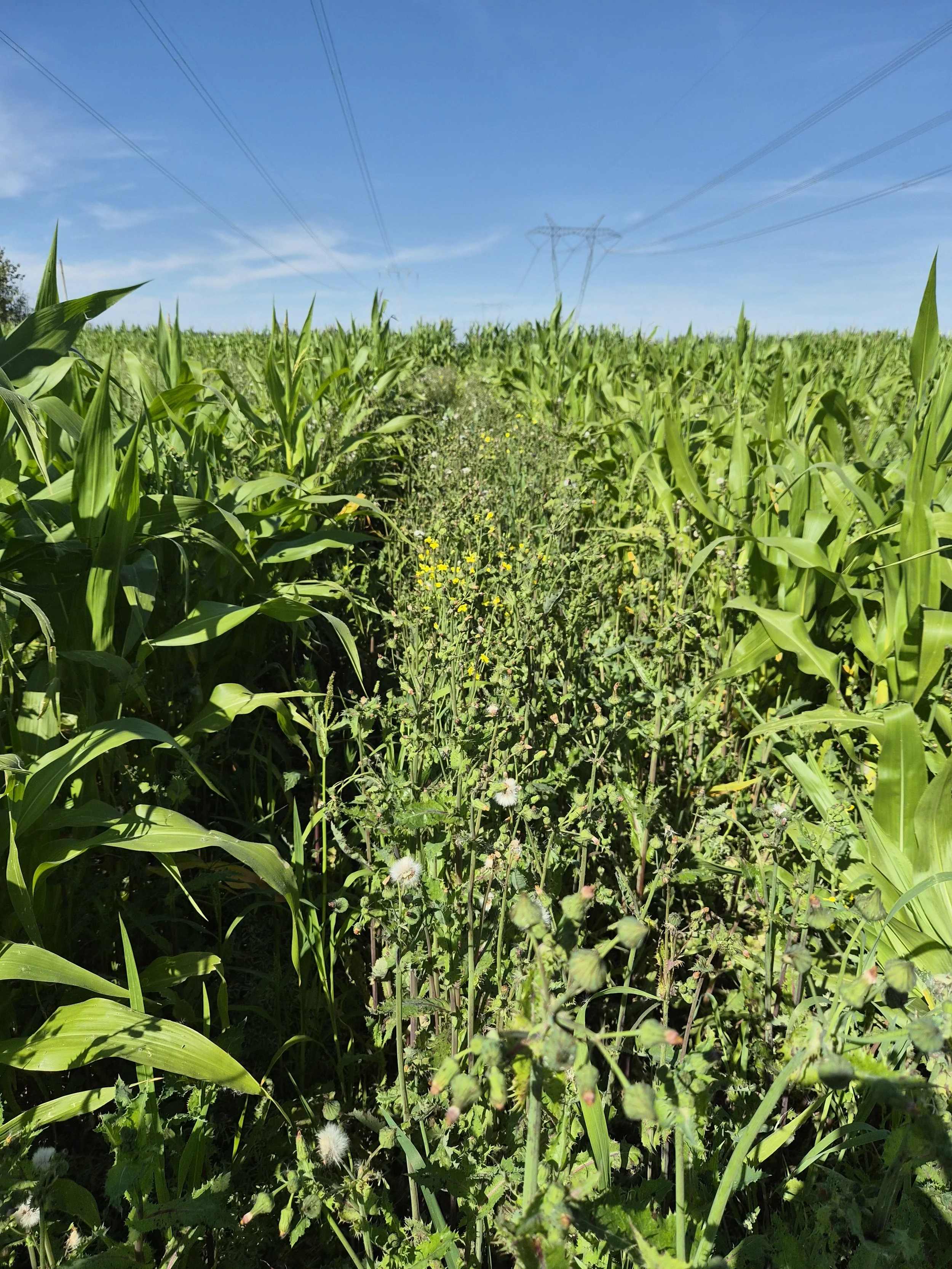
Earlier in the season, some areas had standing water long enough to seriously affect establishment. Weed control became difficult, and plans to get back into portions of the field with equipment had to change simply because it was too wet. Byron described one stretch where even getting a four-wheel-drive vehicle across the field wasn't an option.
And because apparently the mud wasn't enough, Byron tried taking his little spreader across the field and the axle fell off.
"Great!"
It was one more addition to a growing list of things that weren't exactly in the original project plan.
Walking through one particularly stressed area, though, something stood out. Some of the better corn plants were growing in spots associated with previous cattle feeding. Byron explained that the field had been used for winter feeding, although not all areas had received the same amount of animal impact, waste feed or bedding.
Bart quickly pointed toward nutrient deposition as a possible explanation for what they were seeing.
It wasn't a replicated research result and nobody was treating it as one. It was simply an observation in the field, but it was an interesting one. Byron is already thinking about bringing cattle and feed onto more of that ground as part of trying to improve some of his less productive acres.
That is part of what makes a field-scale project interesting. You can measure yield and forage quality, but you also start noticing relationships that give you another question to chase next year.
So, how many species do we actually need?
As we moved into the annual forage mixtures, the conversation shifted toward diversity.
There is plenty of interest in adding more species to annual forage systems, and Byron has experimented with combinations that include cereals, peas and other species. The potential benefits are easy to understand. Different plants can contribute different rooting patterns, growth periods, feed characteristics and functions within the cropping system.
But Bart kept bringing the conversation back to a deceptively simple question: what are you trying to accomplish?
If the primary goal is producing feed for cattle, the system still needs to produce enough usable biomass at an acceptable quality and cost. If the goal is improving soil characteristics, a more diverse mixture may offer different benefits. Most producers would understandably like both, but that doesn't mean the mixture that looks the most diverse in the field will automatically be the best silage crop.
"The jury is still out," Bart said while discussing how increasingly complex mixtures compare with straight corn or cereal crops from a forage-quality standpoint. He questioned whether the priority was soil health, maximizing biomass for the cow herd, backgrounding calves or some combination of those goals. Byron's response was probably the most fitting answer of the afternoon: "It's got to be a balance."
That balance is part of what we're trying to explore with the project. A mixture might offer agronomic or soil benefits, but what happens when it is harvested? How much feed did it actually produce? What is the dry matter yield? What does the feed test look like? What did it cost to grow? And once we account for all of that, how does it compare with a more conventional crop?
And then you have to make silage out of it
Growing the crop is only half the equation. When the discussion turned to harvesting some of the more diverse mixtures for silage, Bart pointed out another complication: not everything in a mixture reaches the ideal stage of maturity at the same time.
So what do you watch?
Bart suggested looking at which species is actually contributing most of the biomass and making harvest decisions around the plants doing the heavy lifting.
From there, you still need the basics of good silage fermentation to work. Bart talked about having enough sugars available for fermentation, getting the chop length right, packing well and getting oxygen out of the pile as quickly as possible. Those are the pieces that help the fermentation process do what we want it to do.
It gets more complicated when one species is ready and another isn't. At some point, something in that mixture has to be the priority.
It was a good reminder that a mixture has to work all the way through the system. It has to establish, compete, produce biomass, be harvestable and ultimately turn into feed the cattle can use. A very interesting-looking field isn't much help if you can't figure out when to chop it.
A wet year can grow a lot of feed, but what is actually in it?
The amount of moisture this year led into another conversation that may become especially important once everyone starts feeding cattle. Bart cautioned producers about what he called "washy feed." In very wet growing conditions, plants can produce plenty of material while the concentration of energy, protein, vitamins and minerals in that material may not be what producers expect.
He recalled another extremely wet year when producers were feeding roughly the same amount of forage they normally would, only to see cows lose condition because the feed wasn't delivering the nutrients they assumed it was. Someone in the group eventually asked the obvious question. We hear every year that we should feed test, so how much more important is it this year? Bart didn't need a long answer.
"Probably crucial."
The numbers worth watching will depend on the crop and the class of cattle being fed, but Bart pointed toward protein and fibre measures such as NDF and ADF as part of understanding what producers actually have.
That also means a feed test shouldn't just get filed away after it comes back from the lab. The value is in matching that feed to the requirements of the animals eating it and figuring out where supplementation or a different feeding strategy might be needed.
By supper, we were feeding bugs
Once everyone made it back from the field and sat down for supper, the conversation kept going. As these things tend to do, it wandered. Feed testing led into cattle nutrition. Nutrition led into the rumen. The rumen led into feed efficiency, cow size, genetics and fertility.
One of the more interesting discussions centred on how much consistency matters in a cattle diet. Bart explained that much of what a cow can get from her feed depends on the microorganisms living in the rumen. Those microbes break feed down into compounds the animal can use, and when the diet changes, that microbial population has to respond as well.
The group compared that with how dairy cattle are commonly fed very consistent diets. Beef cows are a little more likely to get one type of hay today, something different tomorrow and whatever happens to be handy the day after that. Beef cows can handle a fair bit of variation. That's one of the great things about them. But their rumen still has to keep up.
As the discussion put it, you're really feeding the bugs before you're feeding the cow. The takeaway wasn't that every beef cow needs a perfectly formulated ration. It was simply to think about how quickly we make major feed changes, particularly when moving between feeds with very different starch, fibre or protein levels.
Efficiency isn't just eating less
That conversation eventually moved into feed efficiency, and this was another area where the group challenged some fairly simple assumptions.
It is tempting to think an efficient cow is simply one that eats less. But if she eats less and doesn't breed back, that isn't much of an efficiency gain. Bart summed that up pretty neatly during the discussion: if they're eating less but not getting pregnant, "what good is that?"
The answer from around the table was immediate. Fertility comes first.
From there, producers started comparing cow size, feed intake and the size of calves different cows were weaning. One producer talked about weighing cows and discovering a much larger range in mature cow weights than expected, including a smaller cow that consistently weaned a calf comparable to cows hundreds of pounds heavier.
There isn't a neat answer to what the "right" cow looks like for every operation, and that was probably the point. Feed efficiency doesn't exist separately from fertility, longevity, calf performance, available feed resources or the environment those cows have to work in. Which brought us, in a roundabout way, right back to the field.
Maybe the messy years teach us more
It would have been easy to apologize for some of the plots we walked through. Byron occasionally did. There were weeds, thin areas, changed plans and treatments that didn't establish the way anyone hoped. At one point Byron fairly accurately described part of it as a "weedy mess."
In fact, that's a big part of why Farming Forward does projects at field scale. The goal isn't to create a perfect little demonstration plot where everything behaves itself. We want to see what happens when an idea is put into an actual farm system, collect measurements behind it and give producers something useful to compare against their own operation.
This project isn't intended to prove that one crop, mixture, corn variety, seeding configuration or production system is the answer for every cattle producer. We're collecting yield, dry matter, forage quality and economic information so we can start putting numbers behind some of these options. At the same time, we're seeing what happens when those ideas leave the plot plan and meet an actual farm.
Sometimes you get the beautiful comparison you planned. Sometimes it rains, the weeds take advantage of the situation, your timing goes out the window and you find yourself standing beside Bart and Byron staring at a corn plant that looks considerably happier where cattle happened to spend time the winter before.
There is something to learn from both. And if nothing else, the second one usually makes for a better conversation.