Turning Waste into Opportunity: Highlights from Our Leduc Agricultural WasteWorkshop
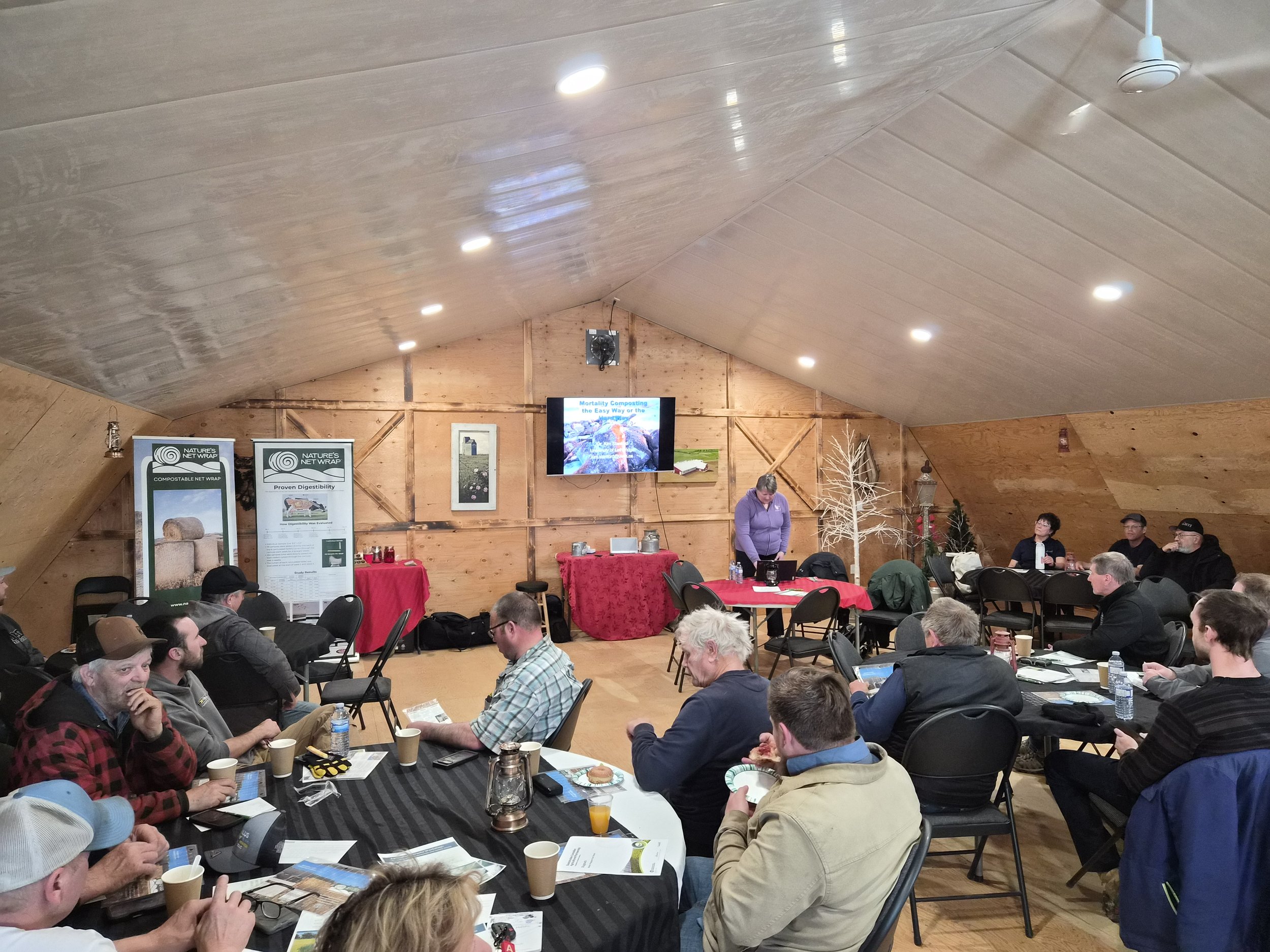
Thank you to Detimdale Holsteins, Dr. Kim Stanford, Assar Grinde, and Nature’s Net Wrap
We had a great day in Leduc this week, bringing producers together to talk about one of the more practical challenges on the farm, managing agricultural waste in a way that works for both the operation and the environment.
This workshop was organized in partnership with Leduc County, and we sincerely thank them for their support in making this event possible. A big thank you as well to Detimdale Holsteins for hosting us in their beautiful barn loft. It was a fantastic setting for learning, and an even better example of innovation in action.
From bale wrap to biology, a full day of practical learning
We kicked off the afternoon with Marty from Nature’s Netwrap, who introduced an innovative approach to bale netwrap. The concept is simple but impactful. The netwrap is designed to stay strong and functional while on the bale, but once it enters a manure pile or composting environment, it begins to break down. Even more interesting, recent research suggests the material can also decompose in the rumen, reducing the risk when processing bales through a shredder.
For producers, this opens new possibilities to simplify feeding and reduce plastic contamination in manure systems.
Carcass composting, getting it right from the start
Next, Dr. Kim Stanford walked us through the fundamentals of carcass composting, focusing on what actually makes a system work in real farm conditions. The message was clear, composting works well when the basics are done right.
A few key principles stood out:
Choose the right location: Look for a well-drained site, at least 350 feet from water, with good year-round access and no contact with livestock.
Start with the right base: A dry, high-carbon base like straw, sawdust, or woodchips is critical. This helps absorb moisture and get the process moving.
Balance moisture carefully: The “squeeze test” is a simple check. Material should hold together when squeezed but not release water, roughly 35–60% moisture.
Carbon fuels the system: Carbon-rich materials are the energy source for microbes. Manure works well as an amendment, adding both carbon and nitrogen.
Oxygen is essential: Compost piles need structure and airflow. Bigger is not always better, but enough mass is needed to maintain heat and avoid excess moisture.
Time, temperature, and turning: The “3 Ts” of composting
Time, around 9 months for cattle
Temperature, aiming for about 55°C for effective breakdown
Turning, typically about three times over the composting period, more is not always better
Small details also matter. For example, placing mortalities on their side instead of on their back, and ensuring each animal is well covered with carbon material, helps improve consistency and results.
Tackling ag plastics, and making it practical
To wrap up the presentations, Assar Grinde from the Agricultural Plastics Recycling Group (APRG) shared updates on Alberta’s ag plastics recycling efforts.
The program continues to grow, with more collection sites and increasing momentum toward a long-term, province-wide system. With Extended Producer Responsibility regulations coming into play, producers can expect more structured and accessible recycling options in the future.
Assar also brought something hands-on to the day, his silage plastic compactor. After the indoor session, we headed outside for a live demonstration. He walked through how to properly shake out, fold, and prepare plastic before compacting, and showed just how simple the system can be to use.
The biggest advantage is transportation. By compacting plastic, loads are denser and easier to handle, significantly reducing hauling time and cost.
Bonus: A look inside a modern dairy
As a bonus to wrap up the day, the Detimdale Holsteins family offered guided tours of
the barn. Participants got an up-close look at some impressive technology in action, including:
Automated climate control systems
GEA milking robots
A Trioliet feeding robot with a fully automated feeding kitchen
It was a great reminder that innovation on farms is happening every day, often in ways
that improve both efficiency and animal care.
Looking ahead
Workshops like this are a great example of what we are aiming to do more of, bringing practical information, real-world experience, and hands-on learning together in one place.
Waste management continues to be a key focus area in our 2026 programming, alongside soil health, rotational grazing, water quality, and on-farm innovation . If you are interested in future workshops keep an eye out on our newsletter or website.
Thanks again to everyone who joined us in Leduc, and to our speakers and hosts for making it such a valuable day.